
A supernova remnant (SNR) is the expanding, diffuse nebula left behind after a massive star explodes. Consisting of stellar ejecta and swept-up interstellar material, this structure is shaped by high-velocity shock waves that heat plasma to millions of degrees. These remnants are crucial for enriching the interstellar medium with heavy elements and accelerating cosmic rays.
Key aspects of supernova remnants include:
Structure: They are typically shell-type (empty center), crab-type (pulsar in the center), or composite, which blends both types.
Evolution: As the blast wave expands, it sweeps up interstellar gas, creating a forward shock and a reverse shock that heats the ejecta.
Significance: SNRs provide insights into the life cycle of stars, the synthesis of elements necessary for life, and the mechanics of high-energy physics.
Examples: Famous examples include the Crab Nebula (SN 1054) and Cassiopeia A.
Supernova remnants can persist for thousands of years, expanding over tens of parsecs (1 parsec = 3.14 light years or 19,170,000,000,000 (19 trillion) miles) before eventually merging with the interstellar medium.
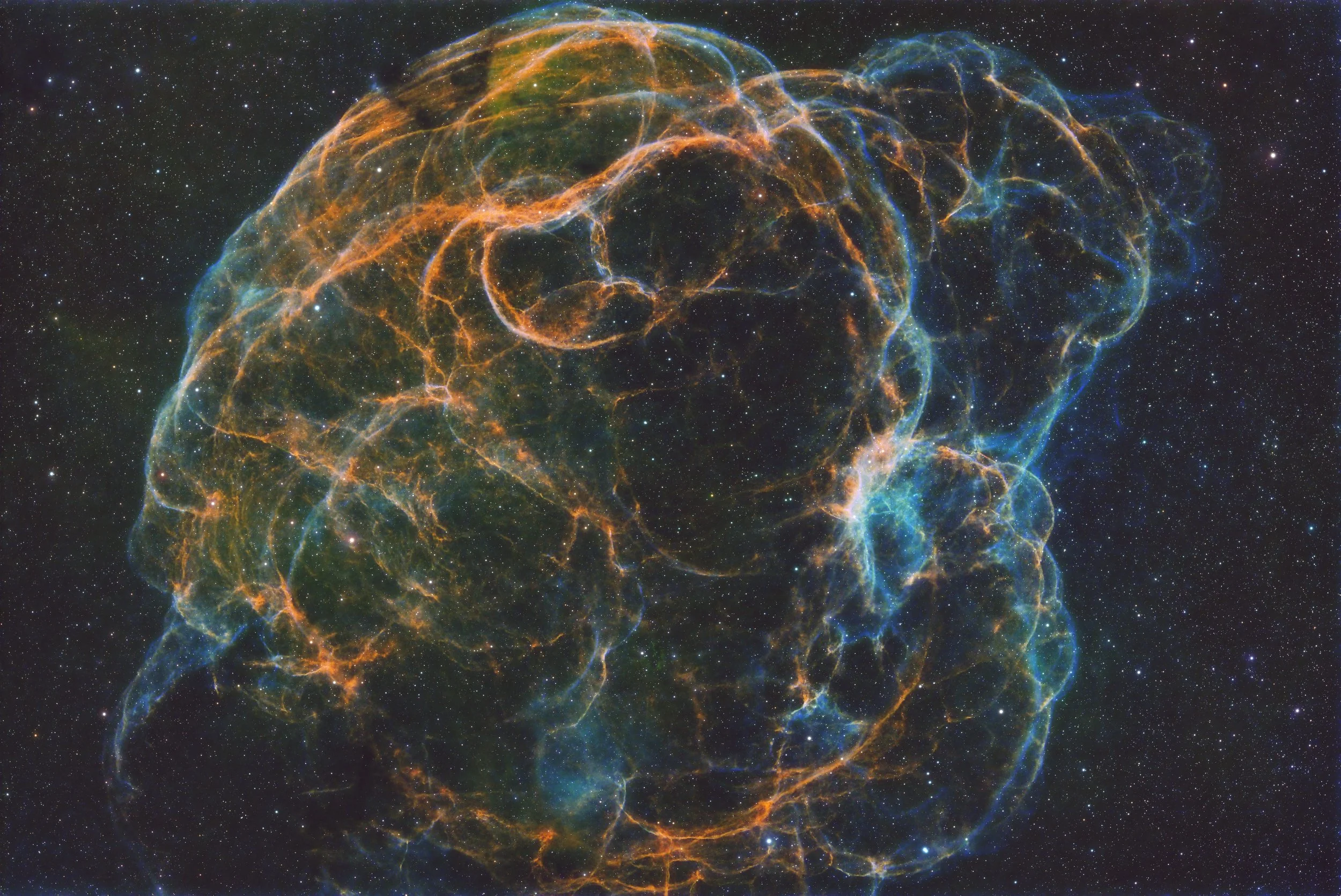
Sh2-240 The Spaghetti Nebula

Caldwell 33 and 34 The western and Eastern Veil Nebulas

NGC 6888 The Crescent Nebula (with inset)

M 1 The Crab Nebula

IC 443 The Jellyfish Nebula